
Crypto Payment Terminal: How It Works and Why Merchants Use It
Contents
If you’ve ever had a customer ask, “Can I pay in Bitcoin?” and everyone behind the counter suddenly found something very interesting to look at on the floor, this is for you.
A crypto payment terminal is basically the “card reader” of the crypto world. Same idea: you enter an amount, the customer pays, you get your money. The difference is the rails under the hood. Instead of Visa or Mastercard, you’re riding on blockchains and wallets and all the fun (and occasionally annoying) things that come with them.
This isn’t a hype piece about “the future of money.” It’s the practical version: what actually happens at the till, what can go wrong, and whether it’s worth the headache for your specific store.
What Is a Crypto Payment Terminal?
Think of a crypto payment terminal as a translator. On one side you have your customer’s digital coins sitting in a wallet app. On the other side you have your business, which probably thinks in euros, dollars, or whatever your local currency is.
The terminal — which might be a dedicated device, a module in your existing POS, or just an app on a tablet — connects to a crypto payment processor or wallet service. That service does the heavy lifting: converting values, talking to the blockchain, and eventually sending you either crypto, fiat, or a mix.
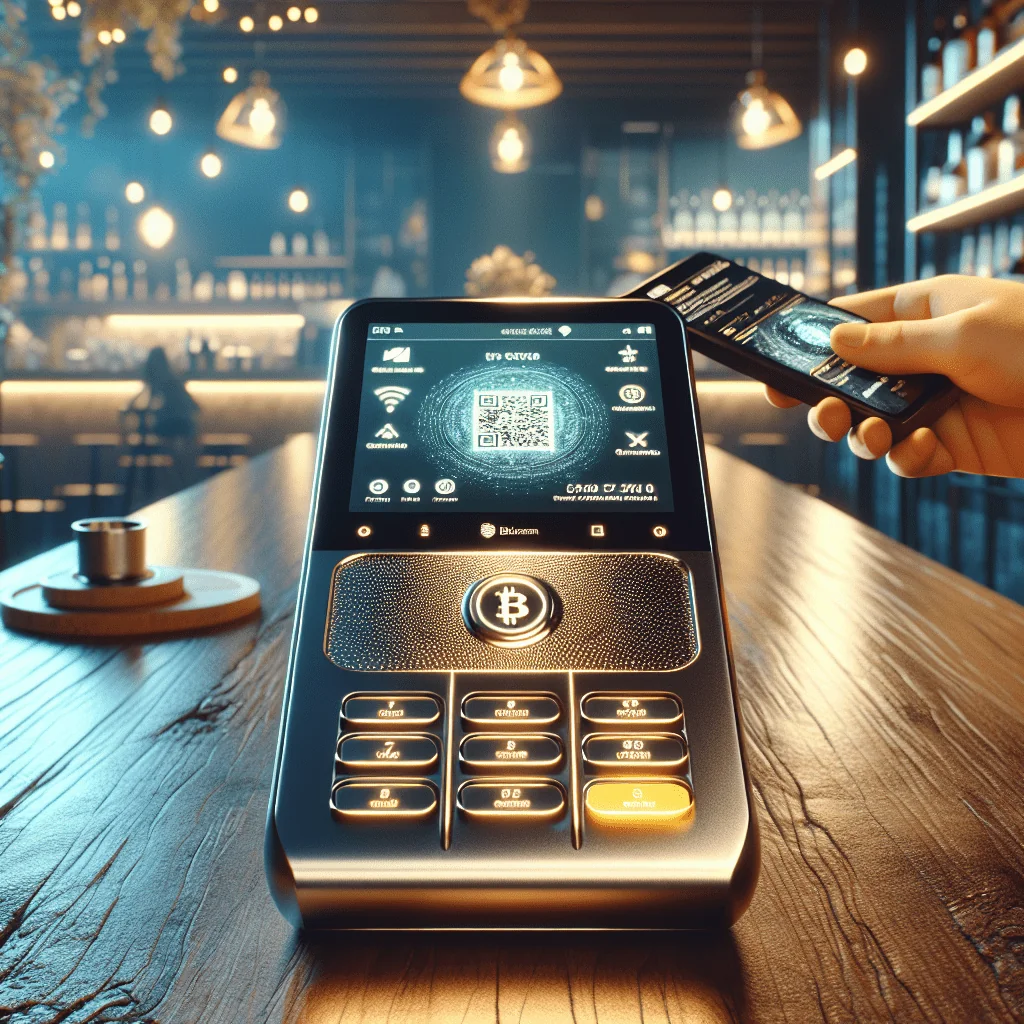
From the cashier’s point of view, it’s not that exotic. You punch in the sale amount, tap “crypto,” a QR code pops up, the customer scans it with their wallet, and somewhere in the background a blockchain nods in approval. The big difference is the payment rail: instead of card networks, you’re using something like Bitcoin, Ethereum, or a stablecoin network.
Some setups come as chunky, stand‑alone hardware that looks like a normal card reader with a different logo. Others are just software bolted onto what you already have. Many of the better ones handle both cards and crypto on the same screen, so you’re not juggling three devices like a circus act at the counter.
How a Crypto Payment Terminal Works Step by Step
On paper, crypto is full of jargon: hashes, blocks, confirmations. At the checkout, though, the flow can be very boring — which is exactly what you want.
Here’s how a typical in‑store crypto payment plays out, without the marketing gloss:
- Enter the sale amount: Your staff does what they always do: enter the total in the POS in your normal currency.
- Choose crypto as the payment method: Instead of tapping “card” or “cash,” they pick the crypto option on the terminal or app.
- Terminal converts the amount: The system looks up a live exchange rate and says, “Okay, that’s 0.000-something BTC” (or USDT, or whatever the customer picked).
- QR code / wallet details appear: The terminal shows a QR code and the payment details. This is what the customer’s wallet will read.
- Customer sends the payment: They scan the code with their phone, check the numbers, and hit send. If they’re new to this, expect a short pause and a slightly worried face.
- Network sees the transaction: Your payment processor spots the transaction on the blockchain and runs a few checks — mainly “Is this real?” and “Is someone trying to double‑spend?”
- Merchant gets a confirmation: Once the processor is comfortable, your terminal flashes some version of “Paid” or “Approved.” That’s your green light to hand over the goods.
- Funds are settled to you: Later (sometimes instantly, sometimes in batches), the provider settles the money to your chosen destination: your bank account, your crypto wallet, or both.
Do you always wait for full blockchain confirmations at the counter? Usually not. Most processors use risk models and give you a “good enough” confirmation quickly, then wait for deeper confirmations in the background.
Key Features to Look For in a Crypto Payment Terminal
Vendors love to drown you in buzzwords. Ignore half of them. For day‑to‑day retail, a few things actually matter; the rest is noise.
- Multi‑currency support: You don’t need every meme coin under the sun, but you do want the basics: Bitcoin, at least one major stablecoin, and maybe a couple of popular smart‑contract tokens. If a customer asks to pay in something obscure, you can always say no.
- Fiat settlement: Unless you secretly want to become a crypto trader, you’ll likely want automatic conversion to your local currency. That way, if Bitcoin drops 10% overnight, it’s your customer’s problem, not yours.
- Network fee handling: Someone has to pay the blockchain fee. Is it baked into the rate? Charged to the customer? Split? You don’t want awkward arguments at the till over a mystery extra charge.
- POS integration: If your staff has to juggle a second device and then manually reconcile sales at the end of the day, they will hate you. Integration with your existing POS, receipts, and inventory is worth a lot.
- Security and risk checks: Look for basics: secure APIs, proper logins for staff, and tools to spot double‑spend attempts. If the provider can’t explain their risk controls in plain language, that’s a red flag.
- Reporting and reconciliation: Your accountant will want clean reports that line up with sales and tax records. CSV exports, clear timestamps, and currency breakdowns matter more than fancy dashboards.
- User‑friendly interface: Big QR codes, clear buttons, and no “engineer‑only” screens. Assume at least one staff member is not tech‑savvy. The system should survive that reality.
If the provider offers a demo, don’t just click around in an office. Put the terminal where it will actually live, during a busy period, and watch how staff and customers react. That will tell you more than any brochure.
Types of Crypto Payment Terminals and How They Compare
There isn’t one “correct” way to accept crypto in‑store. What works for a single coffee stand is not what a supermarket chain will use. Roughly, you’ll see four main setups:
Comparison of common crypto payment terminal types
| Terminal Type | What It Is | Main Advantages | Main Drawbacks | Best For |
|---|---|---|---|---|
| Dedicated hardware terminal | A separate gadget, like a card reader, built purely (or mostly) for crypto payments. | Stable, predictable, easy to explain to staff. Keeps crypto clearly separated from the rest of your systems. | Costs extra, one more device on the counter, and often its own reporting to manage. | Stores that want a clear “crypto corner” at the till and don’t mind one more device. |
| POS‑integrated module | A crypto payment option built right into your existing POS software or card terminal. | One system, one set of reports, less training, cleaner counter. | You’re at the mercy of your POS vendor. Currency choices and features can be limited. | Retail chains or any business already heavily invested in a specific POS platform. |
| Tablet or smartphone app | An app that generates QR codes and tracks incoming payments. | Cheap, quick to set up, great for testing demand or for mobile setups. | Security depends on how you manage the device. Some customers may see it as “less official.” | Pop‑ups, markets, events, and small merchants just dipping a toe into crypto. |
| Self‑service kiosk | A customer‑facing screen where they order and pay in crypto on their own. | Reduces staff workload and lines; fits fast‑food, ticketing, or high‑traffic venues. | Higher upfront cost and more complex to maintain and update. | Busy locations with repeat orders where self‑service already makes sense. |
A common pattern: start with the cheapest, least disruptive option (usually an app or a stand‑alone device). If customers actually use it and it’s not a daily headache, then think about deeper POS integration or kiosks.
Benefits of Using a Crypto Payment Terminal in Store
Putting a “We Accept Crypto” sticker on your door isn’t just about showing off to techies. It can actually move the needle, but not for every business and not in the same way.
First, there’s the “new customer” angle. Some people genuinely prefer to spend crypto — maybe they’re tourists, maybe they’re paid in digital assets, or maybe their local banking options are a mess. For them, being able to pay directly in crypto is more than a gimmick; it’s a relief.
Second, chargebacks. Card payments come with the constant risk of disputes and chargebacks. Crypto transactions, once confirmed, are basically final. That doesn’t mean you can ignore refunds or consumer law, but it does mean fewer surprise reversals weeks later.
Third, cross‑border sales get easier. A traveler can pay in crypto, you get settled in your local currency, and nobody has to argue about exchange rates or foreign card fees. It’s not magic, but it does smooth out some of the usual friction.
Risks and Challenges of Crypto Payment Terminals
Of course, there’s a flip side. If someone tells you crypto payments are “risk‑free,” you can safely move them to your mental spam folder.
Volatility: If you keep the crypto you receive, you’re effectively speculating. Prices can move a lot between the moment of sale and when you decide to convert. That can work in your favor or against you. Automatic fiat conversion reduces this, but you’ll usually pay for that convenience in fees.
Regulation and tax: Crypto is treated differently depending on where you are. Sometimes it’s property, sometimes it’s a currency, sometimes it’s just “an asset.” Each version comes with its own tax and accounting rules. You’ll need to know how your local authorities want you to record these sales, especially for VAT/GST and income tax.
Operational headaches: What happens when the network is slow? Or the customer sends the wrong amount? Or they swear they paid, but nothing appears on your terminal? Your staff needs clear, written procedures for these edge cases. Otherwise, you’ll end up resolving disputes at the counter while the line grows longer and tempers shorter.
How to Choose the Right Crypto Payment Terminal Provider
Choosing a provider isn’t just about the gadget on the counter. You’re picking a partner who will sit between your customers, the blockchain, and your bank account. That’s not a trivial role.
Here’s a simple way to evaluate them, without getting lost in technical sales talk:
1. Currencies and blockchains: Check what they actually support today, not what’s “coming soon.” Do they handle major coins and at least one or two stablecoins? Do they update regularly, or does the list look frozen in time?
2. Fees and settlement: Look beyond the headline percentage. Ask how they calculate exchange rates, what spread they take, and whether there are monthly or minimum fees. Get them to walk you through a real example: “If I process 50 payments of $20 each, what do I actually receive?”
3. Security and compliance: You don’t need to be a security expert, but you should hear words like encryption, access control, and AML/KYC obligations where relevant. If they’re vague or dismissive about regulation, that’s a warning sign.
4. User experience and support: Do a few test transactions with people who are not crypto‑savvy. Time how long it takes. Try cancelling and refunding. Then contact support with a “dumb” question and see how they respond. That’s closer to your real‑world experience than any marketing page.
Practical Tips for Using a Crypto Payment Terminal in Your Store
Once the terminal is on your counter, the theory phase is over. Now it’s about habits and routines.
Train your staff, even if it’s just a 15‑minute session. Walk them through a full payment, a failed payment, and a refund. Print a one‑page cheat sheet and keep it near the till. Under pressure, nobody remembers a 40‑page PDF from onboarding.
Decide your refund and pricing rules before the first crypto payment comes in. Will you refund in crypto or fiat? At the original rate or the current rate? Put this in your store policy and stick to it, or you’ll end up negotiating on the spot with every unhappy customer.
Finally, measure. For a few months, track how often customers choose crypto, which coins they use, how long payments take, and how many issues you see. If usage is tiny and headaches are big, you may scale back. If adoption grows and things run smoothly, that’s your cue to invest in better integration or more advanced setups.